Fermín Martínez
Los pacientes del doctor GarcíaFermín Martínez is a diplomat whose death in Madrid during the siege turns a hidden family crisis into a test of grief, loyalty, and practical compassion. Guillermo finds him laid out in a sealed bedroom in ceremonial uniform, with a rosary in his rigid fingers and a saber and feathered bicorne beside him; the improvised grandeur of the scene contrasts with the loneliness of his final confinement. His death draws Amparo and Guillermo together, and his burial in the Civil Cemetery becomes a promise deferred until the war’s end.
Identity and Background
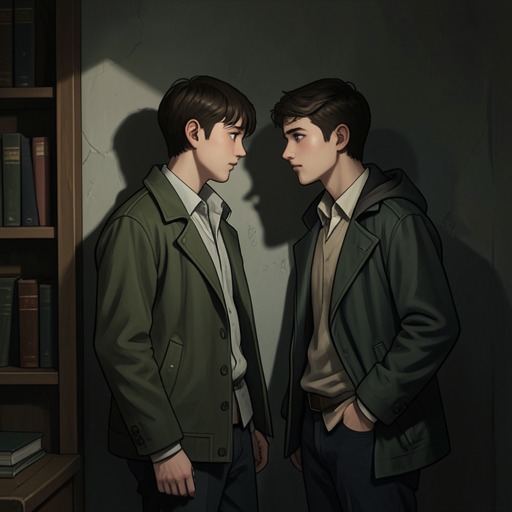
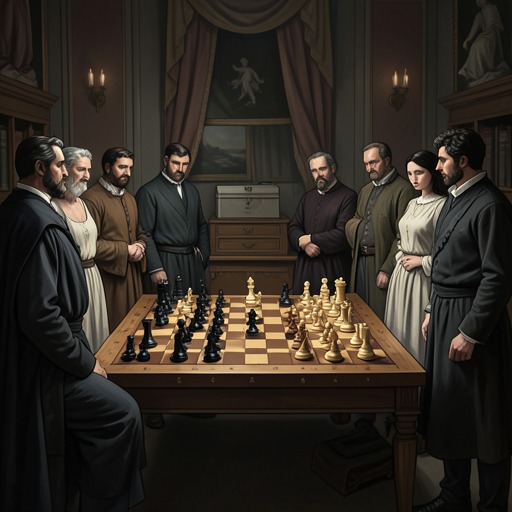
Fermín is remembered not simply as a diplomat but as one half of a decades-long friendship between the two families’ grandfathers. He and Guillermo’s grandfather seemed to have little in common beyond chess: their politics, religion, and moral commitments placed them on opposing sides. Yet both were amiable, curious men who enjoyed conversation and argument, and their connection endured across those divisions. The friendship’s unexplained intimacy gives Fermín’s death a significance beyond the loss of a neighbor; it reaches into a shared family history that had persisted despite ideological distance.
Guillermo had been fond of Fermín before the events of the siege. His mourning is directed not only at the fact of death but at its circumstances: the prolonged, hidden agony of a man shut inside a room, suffering in silence alongside his granddaughter. That grief is sincere, but the siege allows it little time to become ceremony or reflection. Sirens announcing another bombing interrupt Guillermo’s memories and return him to the demands of the living.
Death in the Locked Room
On the morning of 19 November 1936, Guillermo enters the bedroom through a gap in the bookcase, a passage that had belonged to his childhood memories. The smell of decomposition overtakes those memories before he reaches the room. Fermín lies on a carved matrimonial bed, eyes closed and hands crossed over his chest. A rosary rests between his stiff fingers; the tips of his fingers are nearly as blue as the diplomatic uniform in which he has been laid out. A saber lies parallel to his right leg, and a blue bicorne topped with white plumes stands beside his waist.
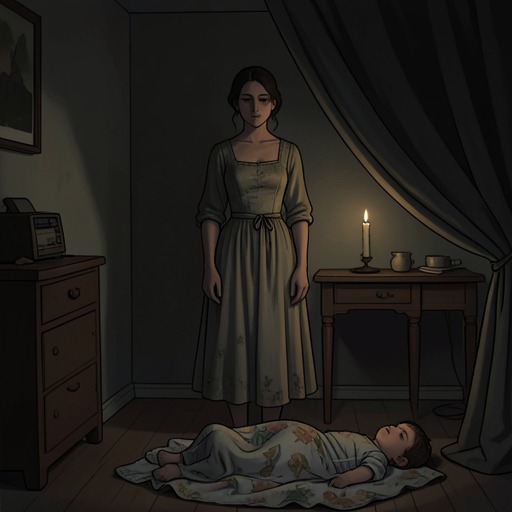
The carefully arranged objects make the body appear almost absurdly extravagant, but the room itself tells a less ceremonial story. The windows are kept dark so that no light can be seen from the street, and Guillermo can tell from the corpse that Fermín has been dead for more than a day. Amparo, dressed in a man’s pajamas, is there in the dimness; the girl Guillermo once knew now appears exhausted and disordered, briefly straightening herself when she realizes how she looks. She tells him that Fermín died the previous morning, Tuesday, 18 November.
The circumstances also reveal how Fermín’s absence had been concealed. In July, when Guillermo met Experta in the building, she had explained at elaborate length that Fermín had gone to San Rafael, where his sister had a house, and that the front had left him on the other side. She said she was cleaning the home despite having heard nothing from him. Now, with Fermín dead in the locked room, that earlier account takes on the force of a cover story. The explanation had left Guillermo with questions, but the urgency of the corpse makes their resolution secondary to what must be done next.
Burial and Its Compromise
Guillermo first brings Amparo away from the bed and insists that the three of them leave the room and speak in the study. The account he later gives at the hospital is not fully faithful to the original version, though it proves more effective. The difference marks the practical adjustments required by wartime: the truth of Fermín’s death must be managed alongside the immediate task of protecting the living and arranging a burial.
At the grave, Amparo wants Fermín buried in the Civil Cemetery, where Guillermo’s own grandfather is buried. Guillermo tells her that this is the only grave he can offer. For the present, he says, the earth is only earth, no different from the ground across the street; when the war is over, he will help remove Fermín’s remains and take him to the cemetery opposite, and he will sign whatever papers Amparo needs. His promise does not erase the indignity of the temporary burial, but it gives that necessity a future condition and a nameable obligation.
Amparo tries to answer and breaks down crying. Guillermo repeats that the decision is final. Then, as she turns in his arms, Experta begins the Lord’s Prayer; Amparo can only join in near its end. The two women say a Hail Mary together, and Fermín is buried. Guillermo places geraniums in the grave and tips the gravedigger. The combination of prayer, flowers, and paid labor gives the burial its plain, improvised form: a family rite carried out under pressure, not a public funeral.
Legacy and Narrative Significance
After the burial, Guillermo gives Experta the keys to his home, where she and Amparo can eat and rest. He has other keys at the hospital and cannot say when he will be able to return; he invites Amparo to take whatever she needs and offers help for whatever may happen. This practical shelter is one immediate consequence of Fermín’s death. His absence leaves Amparo vulnerable, and Guillermo responds by extending assistance beyond the grave and beyond the formal act of burial.
The return to the hospital is framed by a jarring contrast. Guillermo’s taxi still smells of death, yet the prospect of a day of blood, pain, and shattered bodies seems almost welcome beside the hours he has just endured. He soon puts on the only clean garment he will have for many hours and returns to cutting, stitching, and cauterizing as planes continue to pass overhead. Fermín’s death is therefore not set apart from the war’s violence; it briefly concentrates that violence in a closed room, then gives way to the relentless work of treating its other victims.
Fermín’s final tableau also gathers the novel’s concerns with identity and appearances into one intimate scene. His diplomatic uniform, rosary, saber, and bicorne assemble public office, religious devotion, and martial display around a body that has suffered in secrecy. The formal objects cannot explain his death or undo his isolation. What endures instead is the divided inheritance represented by his friendship with Guillermo’s grandfather, Guillermo’s short but genuine mourning, and the promise that the temporary grave will not be the last word on where Fermín belongs.